Showing posts with label Press Play on Tape. Show all posts

8/17/2008

Rise of the Dragon


One of the most ambitious adventure games of its time. Released as early as 1990, Rise of the Dragon offered a somewhat primitive yet immersing cinematic gaming experience. For me.

The plot is not really that complicated (Legacy of Kain came much later) - the setting is the futuristic Los Angeles, looking awfully similar to the futuristic Los Angeles in Blade Runner. Here, however, the year is 2053 instead of 2019 - apparently the game's creators came to conclusion that 2019 was much too early for hover cars, video-telephones, etc... Anyway, the city is on the verge of being torn apart by a malevolent underground Chinese mafia planning on taking over the world by selling a powerful, mutagenic drug. You know, a typical Elexis Sinclair syndrome. Or should I say, SINdrome. After the mayor's daughter falls victim to the organization, a veteran cop-turned-private-eye, Blade Hunter (the name sounds familiar) is called to investigate.

Most of the time, you'll watch the ROTD's rotten environments through Blade's own eyes, or so it seems. You get the general overview of the area and the opportunity to click around an interact with objects and characters. The latter are usually very talkative and once a conversation starts, you'll see close-ups of their faces (their expressions change, depending on what mood they are in), along with available dialog options. Needless to say, your performance as a conversationalist will directly affect the relationship between Blade and a given character, so if you piss somebody off, he or she won't be willing to help you later on, and you'll get stuck. The objects are much easier to handle - through the simple inventory.

Rise of the Dragon also features a time limit. You have precisely three days to solve the case and bring the bad guys down, or you'll loose. The game is especially unforgiving with transportation. Traveling from one location to another obviously takes much time, so you cannot just move around freely, like in, let's say - Broken Sword. You have to plan ahead.

There are also some arcade sequences, where Blade finally uses his gun. Two of them are simple side-scrolling shoot'em-ups, with the opportunity to dodge enemies' bullets by ducking or jumping on platforms; and one is an even simpler mouse-aiming shoot'em-up. Fortunately, if you happened to suck at these, the game offered to skip them - very thoughtful of the developers.

A word about conversions. In 1991 the game made its way into Amiga (10 floppy diskettes) and in 1993 into SegaCD, in a very deformed shape. For once, it featured voice acting with Cam "I'm you! I'm your shadow!" Clarke himself voicing Blade Hunter and all of the subtitles got removed. Yet, the consoles of that time were less capable than home computers, so the color palette got narrowed down to 64. Apart from that, Rise of the Dragon was one of countless victims of early nineties video-game-brutality paranoia. Many things, from lap dancers in night clubs to ammo clip innocently lying on Blade's desk, were removed. Strangely enough, you couldn't skip the arcade sequences this time.

If you already know Rise of the Dragon, you might know Heart of China - a very similar adventure game, this time borrowing heavily from Indiana Jones series, released one year later. Both games are very important classic titles, offering a much more sophisticated approach to adventure genre than their predecessors and being an inspiration for many great later titles. For all of you vintage-fans out there - simply must-plays.

7/25/2008

Future Wars


Future Wars is an early project of Delphine Software team, which involved both the creators of Flashback and Another World. That is the reason I bought it many years ago. It’s a straight-forward point-and-click adventure game.

I read the manual telling some science-fiction story about aliens traveling through time in order to invade our planet. The plan was cunning indeed – place the bombs (or some equally destructive alien technology contraptions) where the generators of Earth’s force field would be built. Excited, I watched the intro showing some people fried by laser beams, only to begin the game as... a window cleaner. A window cleaner? Where’s the future, where are the aliens, the laser beams?

Okay, okay... I know the protagonist gets to that pretty shortly. I just wanted to express my initial surprise at playing as a window cleaner, whose life’s pleasures consist of making pranks on his boss. In the end, the idea is simple; after all, what a sci-fi story can be about if not about – all together now – SAVING THE WORLD!!!

As you can see, if you scroll down a little, Future Wars is darn good looking, considering its release date: 1989. It features a lot of text, showed in pretty, shaded boxes (which in the DOS conversion got colored): some dialogues, but mostly funny comments coming from the faceless “narrator”. You get a feeling that the creators didn’t want the game to be very serious. The interface is everything you’d expect from an early adventure game: the action menu with a lot of options. Thankfully, it’s not very complicated and after a couple of minutes, it even gets intuitive and natural. Still, there are places where it can be a pain. For example, typing a code to a security keypad. Once you examine it, a convenient image is displayed, showing all the keys. You think all you need to do is click on them? Nossir. You bring up the action menu, choose “OPERATE” and then click on the first digit. Then you bring up the action menu again, choose “OPERATE” and then... You get the pattern? And all of this happens while the ceiling is slowly coming down on your head.

The game does commit two sins which the gamers of today won’t easily forgive. The first one is an enormous amount of pixel-hunting. Apart from some cases where you can clearly make out a pickable object, taking things (and figuring out places to put them into) usually takes some frustrating moments of moving your cursor across the screen, searching for the right spot, like one single branch on a tree which has at least twenty of them. Secondly, you can get stuck. All it takes is not to pick up a plastic bag from the waste basket and later, having traveled back through time, you’ll discover you can’t dispose of the vicious wolf guarding an area. In the past, the solution was simple: either being extra meticulous in scanning the screen or saving a lot, or both. While in the nineties many games offered a possibility to reach a dead-end (I remember one semi-erotic adventure game called Fascination where you had to replay pretty much the entire thing if you hadn’t picked up a newspaper or some shit at one point), today it would be considered an unforgivable blasphemy.

Moving around is another nuisance. How do you do that? Well, you move the cursor to the destination spot and left-click. Sounds simple and, in most cases, it is. Yet, there are places in which this can drive you bonkers. Take a look at the swamp on a screenshot below. Your task upon arriving there is to make your way to the left of the screen, to the mosquito nest. To do that, you have to walk precisely on the dark green pixels and if you make one step on the dark-gray ones, you drown and have to load your last save. It is perfectly doable, you just have to be patient, but is such an aggravating sequence really necessary in an adventure game? Plus, there are some arcade stages, one of which is making your way through the maze of platforms (in a Flashback style), with a timer counting. Twice. Boy, was that a bad idea.

Okay, the final paragraph. As most games in Press Play on Tape, Future Wars is a granddaddy and we tend to forgive our granddaddies a lot of things (even the smell). Especially if they still look kinda good. Besides, it’s still considered by many to be one of the best point-and-click titles of all times and, even though it took me a lot of nerves (and years) to finish it, I must admit I liked it.

7/14/2008

Project Firestart


A cute little thing from 1989 which you might call one of the first action-adventure games.

Ye plot:
You are some sort of hot-shot alien shooter send to some space research station conducting genetic experiments. Their radio went dead, you're there to find out why then blow the thing up.

Ye graphics:
As you can see below - an average example of Commodore 64 quality. Still some images look pretty decent, like the monster in the middle picture, or the outro sequence, which I didn't want to spoil, just in case you care.

Ye sound:
The beeps are few and far between, except for the monster tune, which is aggravating.

Ye gameplay:
Even though the game is side-scrolled the locations are 3D (like the city outskirts in onEscapee), which means there are intersections where you may choose which way you want to go, plus riding elevators. This can be a little confusing, since all the linking corridors, leading to different rooms look exactly the same (this smells of Penumbra), fortunately they are labelled with letters, so if you happen to have a printed map...
Monster encounters are not very pleasant, because the energy tends to fall and so does the ammo. There are a few weapons to be collected in the station, but before you are allowed to take one, you have to deplete the ammo of the one you already have. This seems weird today, but what wasn't in 1989?
There are a couple of nice touches like some plot-turns (even in spite of the simplicity of the plot itself), occasional surprises like the power-downs, images zooming on some interesting objects (mostly eviscerated corpses). There's also a quick intro, and an early-Hollywood-sci-fi-production-resembling outro.

Ye bottom line:
The C64 equivalent of Dead Space. ;-)

7/01/2008

Beneath a Steel Sky


Before the Broken Sword, there was a Steel Sky. Before George Stobbart, there was Robert Foster.

Oh, but I don't really have to tell you that, have I? After all, if you are 20 or more, you'll probably remember the forgotten video game genre, called point-and-click. Forget gamepads; use your mouse - and not for moving the crosshair, but a cursor. Not a lot of new games have cursors in them during the gameplay, right? Point-and-click was a once a firm genre, one of the most important kinds of game out there and the pride of computer owners. Console games of the past (grand-grand-gen) tended to be very simple: 4-directional pad and 2 action buttons (four, if you were lucky) so all they seemed to offer was platformers, shooters and driving games, while PCs, Amigas, Ataris, MSXs and even Macs flourished with games which required more complicated controls - adventures, managerials, turn-based strategies, real-time strategies, Microsoft Flight Simulator... Today, things are different, as everything tries to be as straight-forward as possible. A game where you have to become a member of an exclusive, private club just to obtain a glass with some fingerprints would seem totally illogical and crazy (on the other hand, show me a point-and-click title where you have a next-gen console with an opportunity to "buy money" for your game; dig this - you spend money for some points you spent to buy money!).

Anyway, back to B.A.S.S. I'm not going to tell you anything about the plot - that's because either you know it already, or I'm not going to spoil the fun in case you've never played it before. Suffice to say, it's the cyberpunk future (yummy...), the society is divided into classes, where the snobs are living on the ground in their posh apartments while the slums are working hard in the rusty sky-high factories above the clouds. There's a sinister computer controlling everything and there's one man with American accent from outside the city on a crusade to figure what the hell is going on.

The graphics are of a decent, slightly-worse-than-Broken-Sword quality, the music is not altogether pleasant, but will do, the interface is pretty intuitive. The collection of items in your inventory is placed neatly in the upper area of your screen, as are the dialogue options, and there's not too much pixel hunting. Also, the flow of the story is very entertaining, which is a trademark feature of Revolution titles. The game bursts with jokes and funny dialogues read by actors with either a French of British accent (Irish, maybe) - the accent itself is another trademark of Revolution Software. :-)

Okay, this was a short episode, but, let's face it - who doesn't know Beneath a Steel Sky? If you haven't played it - you can download it for free from Revolution's website (the new SCUMMVM engine allowing it to work flawlessly on newer platforms), even check the official spoiler-free walkthrough if you happen to get stuck. I strongly encourage you to do so.

PS. About a year a go, Tony Warriner announced that Revolution was working on a revamped version of the original Broken Sword: Shadow of the Templars with some extra plot and other stuff thrown in. The game is to be released on DS and Wii. They keep quiet about the project, but I look forward to it just the same. The world needs it.

6/24/2008

Code name Hell Squad


Code name Hell Squad (previously called "Hellpigs" :-) was supposedly the last game on Amiga 500, which is not surprising given its release date - 2000! (one other famous 2D title of Y2K was Red Alert 2). It's a completely old-fashioned adventure game with some shooting thrown in and a ton of hilarious dialogues - for an action-adventure game freak like myself, this statement alone is a recommendation.

The story involves some wicked alien teenager getting his hands (tentacles?) on a space travel technology and spreading chaos throughout the Milky Way, just for the hell of it. But fear ye not, for here comes the U.S. government to the rescue, sending the group of four incredibly skilled, incredibly well equipped, WE-EAT-RAMBOS-FOR-FUCKING-BREAKFAST-DUDE soldiers. The game begins.

Even for an old-school adventure game, Hell Squad has some "innovative" features. First of all, we use joystick and keyboard only, which immediately sets the pace of the game into action-style instead of slow point-and-click. Next, we get to control four soldiers - one at a time - each having his own health bar. While we run around picking items and shooting creatures with one of them, the rest is put into some kind of desaturated suspension state and their health bar slowly replenishes. The inventory however is shared, so we can pick something up with one grunt than switch into another and immediately use the item somewhere on the other side of the map, which is extremely handy. Apart from that, there's just the casual stuff you'd expect to find in any other adventure game - picking objects, using objects, talking to people, etc. Every now and again, we shoot some enemies and bosses which is not very hard, since the ammo is unlimited.

The true magnet of this game is the humor. Almost every line of dialogue has that distinctive lighthearted adventure game humor in it, sometimes sprinkled with a heavy dose of good old American cursing. While playing, be sure to click around the screen and read the comments, some of them are downright hilarious. Even the intro and outro sequences - shot by an actual camera with real "actors" involved - are funny, in a B-movie way.

The graphics are nice enough, not mind-blowingly good or bad, but nice enough. Everything except for the characters has been hand-drawn, while the soldiers and NPCs were digitized, like in Mortal Kombat. The animation is moderately smooth, with many different movements captured, which looks much more realistic than, let's say, Phantasmagoria (shame on you, Roberta Williams). Also, the character gets smaller or larger on the screen, depending on how far/near he goes and in some locations he gets colorized, according to the available source of light. These quite professional touches blend with the absolutely crazy design of monsters and locations. Some of the creatures look really scary like the red sand monster encountered more or less halfway through the game, but on the other hand - just look at the dragon on the screenshot below. Does this thing look laughable or what? Same thing with the locations - some look impressive, some were just meant to be lame, like the mountain cave entrance which look like a cartoon ghost face.

While most of the old point-and-clicks feature some comedy here and there, Hell Squad is all about comedy. Yet, for a title released that late, on a long-since-dust-biting platform, the game is surprisingly well-written, presentable and immersing, even if it lacks that Broken Sword polish and impeccable quality. So, my suggestion to all of you old-school adventure game fans: well, it won't hurt to give it a try...

6/22/2008

Rayman

Rayman

First of all I would like to apologize to everyone for not submitting the Press Play on Tape and Open Your Ears episodes in time. This happened due to technical problems and a general lack of time in recent days. Still, we're back now, and our columns are back with us.

Rayman was created by Michel Ancel in 1992. Rayman is a limbless character that is a star of one of the best 2D platformers of all times. Rayman also was the main star of two 3D platformers. The first of the two was one of the best in its genre just like its 2D predecessor. The third one wasn’t that good, but was still a solid and very fun platformer. Rayman is the reason why UbiSoft is such a powerful company today.

This time however I will focus on the first game.

The game was released in 1995 for the ill-fated Atari Jaguar and MS-DOS and later converted to Playstation and Saturn.

The plot is extremely ridiculous, but we need to bear in mind that it’s a platform game from the mid 90’s of the previous century.
The people of Rayman’s world live in harmony with nature and themselves. They are protected by the great Protoon that watches over the world. One day some hooded bastard (called…now brace yourselves – Mr. Dark) steels the great Protoon and beats up Betilla the fairy when she tries to stop him. The Electroons that were gravitating around the great Protoon scatter around the land and are captured by strange, hostile creatures.
It so happens that only our main protagonist can collect them all, get the Protoon back and bring the balance to the world once again.

Sweet Lord! Thankfully you don’t need an elaborate plot to have fun with a platform game.

Rayman is a typical scrolling platformer, but the level design (both technical and artistic) is so well done, that it’s incredibly fun to run around and free the Electroons from their cages. However, you won’t be able to get to all the cages until you acquire the appropriate powers, which include, for example “shooting” Rayman’s fist and the series and character’s trademark move – the helicopter – where our limbless hero uses his hair to glide over short distances.

The game requires you to complete five worlds (a few dozen levels) and rescue all the Electroons before you’ll be able to face the final boss. You will have to do some backtracking to achieve that, but it’s not too daunting. This all makes the game to be rather lengthy and demanding, and sometimes a bit frustrating. Still, games during that period were mostly more difficult that what we have now (excluding High Mile Club on Veteran in Call of Duty 4 - damn you Infinity Ward).

The game is really beautiful, even for today’s standards. The backgrounds are multilayered and detailed and characters fantastically designed and animated. Especially our hero who features a set of fluid animations that will crack you up on occasions (the grimace animation is just hilarious).

Unfortunately the sound didn’t age as gracefully as the graphics and can be a bit annoying.

A few years back the game was converted to the Gameboy Advance and recently it was released on the European Playstation Network. I encourage anyone with a PS3 to give the game a try, because it’s ridiculously cheap and looks really good upscaled to HD.

Since I couldn't find proper images from the game I strongly encourage you to check them out on MobyGames.

6/10/2008

onEscapee


A couple of months ago, I reviewed Another World and Flashback and promised to have a look at one game which draws heavily from both titles. A long time Amiga gem, it has been made downloadable for PCs, completely for free, here.

There are some great things about onEscapee and some not-so-great things, which prevent it from becoming a true classic, worthy to sit right next to the two Delphine Software miracles. At the first glance, almost everything seems perfect - the stunning intro, the great music (although I still think the guy who sings the tunes could use some singing lessons... and maybe less beers, for that matter), the wonderful background graphics, especially the water levels. But then you notice the release date, which is late 1997, you remember that this was the same year G-Police got released, what's more, Quake and Tomb Raider were already out since 1995. At that point, you frown and start to wonder, why the hell doesn't this look even better? Just as you wanted to say "for its time, the game looked brilliant."

The truth is, onEscapee truly looks like it should have been released 3, maybe 4 years earlier, and not exclusively on Amiga, of all things! Amiga, which at that period of time, was a sinking ship. After all, how many of you (collectors not included) owned A1200 with the external CD-ROM drive, while you could have just as easily bought a PlayStation? So what was the point, anyway? What were they thinking? Well, if you take the graphics, the copy-and-paste Another World controls, the picture becomes clear enough. I guess it was meant to be a revival of the classic. One last look at the AW/F, which is a genre by itself. And if you treat it that way, you might like it.

The plot is not entirely coherent, but it's something about aliens abducting earthlings ("all healthy, strong men") towards purposes unknown. Our hero, David White (I learned the name from wikipedia) is one of those unfortunates, fortunate enough to escape and try and make his way through the hostile world. Just like in Another World, most of the screens feature at least one way to die, each death scene depicted by its own high-quality animation. Just like in Another World, you start in some underground caverns crawling with unfriendly life-forms, ready to eat you alive when you're not looking. Gradually you make your way towards some hi-tech android factory, where you get to shoot your laser-gun multiple times, then there are other places, including the gloomy outskirts of some futuristic city, the beautiful waterfall area and another space location, which is the final one. The game is quite simple - you run, shoot the enemies, run back to the regenerator to replenish your health, solve some really nasty button-pressing puzzles, run some more. The controls were not as fluent as in AW/F, although miles ahead of Heart of the Alien, thank God. The interesting thing is, that though there are some cutscenes here and there, not a lot of words are actually spoken, except for the initial introduction and the singing guy. Maybe it give the game a little poetic atmosphere, but at the same time, is confusing as hell. At the atmospheric outro sequence you find yourself wondering "How the hell did I end up here?". Again, in AW it was the similar thing, but the game was so perfect and innovative you simply didn't care and F has dialogues which eliminated the problem.

What more is there to say? Nice background (if you forget about Resident Evil), nice intro (if you forget about G-Police), decent enough gameplay (if you forget about Tomb Raider) and some tedious puzzles. All-in-all, the game is a complete, not exactly successful, AW/F derivate, for better and for worse, so I recommend it only for those who lust for the two original games and want to play some more. My guess is, you won't be all that disappointed.

6/03/2008

The Killing Game Show


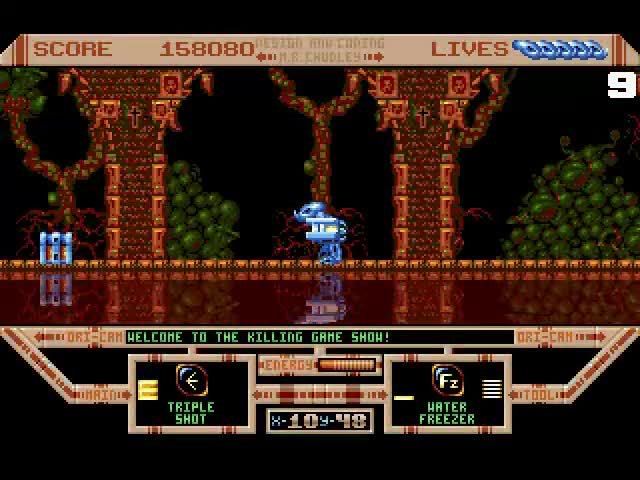
A fabulous looking, fast-paced platformer on Amiga from the creators of Project Gotham Racing and the XBL classic – Geometry Wars.

The protagonist is a little robot, capable of running (duh...), jumping and climbing, as well as shooting things with its twin cannons. There are 8 levels – 2 stages each – and your goal is to make your way from the bottom to the top of every one. There is a time limit in a shape of water (according to the story that thing is actually some ultra-destructive liquid, but... who gives a spit, anyway?). At the beginning of each stage, you have about 10 seconds and then the water level begins to rise. Needless to say, the robot is not waterproof, so all it takes is one badly-timed jump or just running around a little too long and it’s over. Obviously, the creators thought that jumping on the platforms alone would be too easy, so they imbued the game with all kinds of puzzles – you need keys to unlock passages, press switches, avoid malicious traps. On the seventh level jumping is not allowed, so you need to utilize elevators and teleports to move around. Moreover, most of the second stages feature collectible items, for example gems, which give you additional scores. The really cool feature is the replay you get each time you die – while watching it, you may press a key to resume the game from any point you are currently on.

I did mention shooting things, didn’t I? The enemies come in formations (lines, actually) and shooting down the entire line awards you with a score bonus and some additional health represented by a tiny winged heart. Be careful though, as the heart is sometimes replaced with skull which is a health penalty. There are multiple types of ammunition scattered around the stages – each one is limited, except for the most basic one you begin the stage with, and you can carry only one ammo type at a time. The same thing goes with “tools” – these are various bonuses like the water freezer (it temporarily stops the water level from rising), the oracle (gives you good advice), health packs and keys. Again, you may carry only one of them at a time (each time you pick something up, it trades places with the thing you already have) so hunting for a certain shape of a key while having to open five different locks on the way can be a demanding memory and orientation exercise. The only, and I mean, ONLY thing to help you is the overall map of the stage which you can bring up any time and plan your route.

The game may look like a mindless shooter, but in fact, it concentrates more on thinking and taking quick decisions. It’s not particularly easy (the first time I played it, I was nine years old and it destroyed me), but is actually very fun to play. The graphics are outstanding on Amiga, especially the water reflections, just a little worse on Atari and Genesis; the music is decent and the sound effects are both strange and funny. Too bad you have to pick either sounds (the levels seem unusually silent) or music (just one tune on all the levels, which may get boring), not both of them, but well, the technology wasn’t there yet. One other thing to catch your attention is the opening cinematic introducing our cute little robot – very grim and of high quality, it reminds me of Walker.

There is some crazy story behind the game, but who cares? The point is, if you feel like playing something old-school, which requires more than just constantly tapping the “fire” button, look no further.

5/27/2008

Fiendish Freddy's Big Top O'Fun

Fiendish Freddy's Big Top O'Fun

Behind this particularly long title hides a game that was my absolute favorite among many Commodore 64 multi-event games. The thing that distinguished Bit Top O’Fun from all the sports game was the setting (the circus) and the fact it actually had a plot. The game was filled with black humor and a surprising amount of brutality.

The plot was fairly simple. The circus owns a businessman (Fiendish Freddy) some heavy cash - $10 000 to be exact. Freddy wants to demolish the circus and in its place build a luxury hotel, but if the player will manage to raise the money the circus will be spared. The show master organizes a series of six events that are supposed to astonish five clown judges who will pay the player money. The sum is proportional to the display of skill, so it’s the player’s job to impress the judges. However, Freddy would rather build the hotel than get paid by the circus so he will do anything to stop the player from succeeding in raising the funds.

As I mentioned before there are 6 different events:

Diving
The player must jump from 4 diving boards placed on different heights into containers with water. The containers are getting smaller with each board and they range from a huge, wooden bowl to a glass. While the player falls down from the board he must perform stunts to increase the judges scoring. Freddy will occasionally try to blow the player off course with a big hairdryer.

Juggling
The player must endure 4 juggling sessions while raiding a unicycle. Each session bring more balls to juggle as well as babies that must be thrown back to their prams, bombs that must be thrown back to Freddy and missiles that must be juggled until the session ends. Dropping a bomb or a missile ends with an explosion and death of the unfortunate juggler.

Trapeze
The goal is to get from left side to the right side. Simple, huh? Not really. You will have to jump though fire and time your jumps well, as some of the ropes are moving back and forth. Not only that. You need to be fast enough; otherwise Freddy will fly up on his jetpack and cut you down with a pair of large scissors.

Knife throwing
The player must throw at balloons placed on a spinning wheel with an assistant strapped to it. The number of knifes is limited and b sure not to hit the assistant as she bleeds extensively. Freddy will throw smoke bombs to make your, or rather your assistant’s life miserable.

Tightrope
The aim of this challenge is to walk the tightrope from left to right with a pole to keep balance and deflect (with the afore mentioned pole) razor blades that Freddy will be throwing. If you fail to deflect a blade you’ll be treated with an animation the character being cut in half.

Human cannonball
Last, but not least we have the human cannonball challenge. The player must judge the angle necessary to launch the character safely. Be aware, that if you take to long Freddy will detonate the cannon.

The game was released in 1990 for 16-bit Atari ST, IBM PC and Commodore Amiga and was converted a bit later for C64, ZX Spectrum and Amstrad CPC.

I had it on C64 and was lucky enough to have it on a cartridge, as the tape version featured a terrible multi-loading system.

Fiendish Freddy's Big Top O'FunFiendish Freddy's Big Top O'FunFiendish Freddy's Big Top O'FunFiendish Freddy's Big Top O'FunFiendish Freddy's Big Top O'Fun

5/20/2008

DreamWeb

Dreamweb

You are nobody, a bartender trying to live your insignificant little life. Then at some point, you start having intense nightmares about murders and despair... and an enormous mass of energy created by human thoughts and dreams, called [insert game title here]. Finally, when you're on the verge of losing your mind, you are contacted by some mysterious hooded figures, who order you to kill seven people.

Along with Syndicate and Rise of the Dragon, DreamWeb was one of the games which introduced me to a world of gritty cyberpunk - the thing which I lust and long for even now. Back in early nineties no one apparently thought that future computers would be contained in sexy aesthetic white or aluminum cases (like, let's say, iMacs). Nah, everything is dark, dirty steel. No user friendly GUI's, just lines and lines of yellowish text. What about the outside world? Nice futuristic glass skyscrapers over clean streets with hover cars? Nuh-uh, black, steel towers over filth and gutters. In the middle of all that - you having a crammy apartment (shelter), pretending it's not a prison. God, I love this...

The game is easily recognizable by its peculiar interface: the location you are currently in is shown from a top-down perspective, taking only a relatively small portion of the screen. In the bottom left corner there's a zoom window, which follows the cursor and shows the (un)interesting objects. Thank God for that, because it effectively reduces the amount of anger you might build up during the the hunt for pixel-sized items. Speaking of the interesting objects, the inventory screen might be a little bothersome to navigate (mostly because of the three sections you have to click your way through), but I guess it couldn't have been helped, since that was the only way of showing a 36-slot inventory in the era of low resolution. Oh, and you can pick up almost everything - any piece of junk or garbage can be placed in your inventory, even if it's not used for anything (which is mostly the case). About one fifth of the screen is taken up by the image of the Ryan the protagonist, which remains the same throughout the game, except for the sunglasses which you might wear. There's a lot of reading - an obvious thing, since it's an adventure game. The CD versions feature the dialogues read by actors, but in exchange, some scenes got censored (have you ever had sex with your underwear still on?).

There is gore. No gallons of blood, but still. The murders are very graphic and detailed. Curiously enough, I've never felt any satisfaction upon committing them, although shooting people in video games is and has always been one the most stress-relieving activities in my life. Sometimes you, the player, truly feel guilty about what you have just done. Take a look at the last screenshot below - not too many games give you that king of thing... The oddest thing is, Ryan never actually seemed to share my guilt, he just went on with his crusade, never once raising any questions. At one point I started to suspect that he might actually be insane, the whole thing, the DreamWeb, being the product of his deranged imagination. But you know what? I was wrong. The DreamWeb was indeed true and that is the insane thing about it. The crazy world, with Ryan being just a puppet, doing what he was told, or programmed.

Save the best for last - the soundtrack. While the Amiga version features music which is decent enough, the PC soundtrack was just superb for its time (even today it stands strong). Composed by Matt Seldon and Tony Dillon (I don't have a slightest idea who there guys are ;-P), it contains steady, very emotional tracks, more than fitting for the game's dark environments.

So there you have it - one of the most important titles of the old times. A piece of a long-forgotten art of making adventure games. I urge you to check it out.

Intro sequenceThe first victimLocation selectionComing back to the Dreamweb...